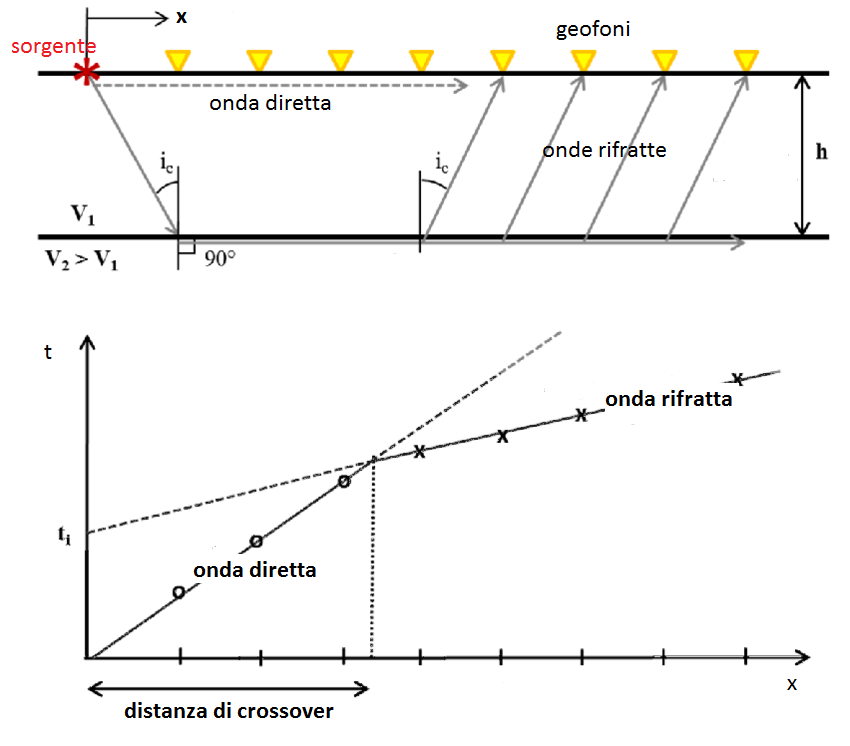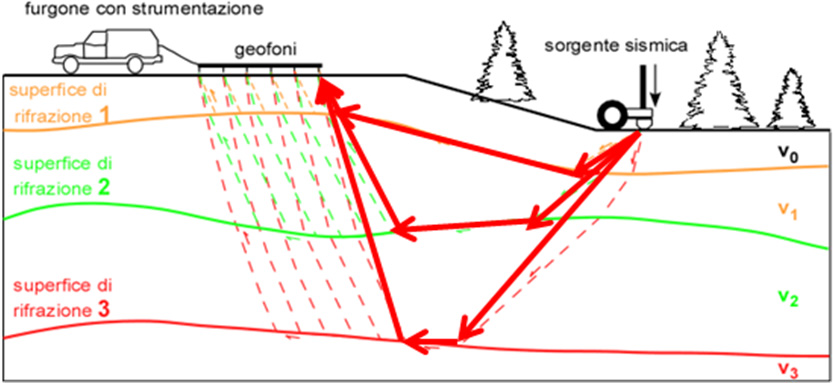
The refraction seismic method is one of the main geophysical investigation methods for the study of the superficial part of the subsoil, it is in fact used to explore depths, from a few hundred meters up to 1-2 km. This methodology consists in generating an elastic wave through an energy source and recording the direct wave and the waves refracted by the discontinuities present in the subsoil, through a set of receivers called geophones. The seismic waves induced in the subsoil give rise to a refraction whenever they meet an interface between two means characterized by different physical-elastic parameters and, therefore, by different values of acoustic impedance. The fundamental condition for performing a seismic refraction survey is that the velocity of propagation of the seismic waves in the layers to be investigated increases with depth. Only in this case, for an angle of incidence called limit angle, the angle of refraction is equal to 90 degrees and the refracted ray will travel along the interface between the two media. Using therefore the distances between the bursting point and the reception point and the first arrival times of the seismic signals, we obtain the dromocrone (time-distance curves), from which we can obtain, through appropriate processing, the real velocities in every single layer, their thickness, depth, shape and inclination. The sources of energy used in the refraction seismic methodology are explosives, hammer-plates or weight drop.
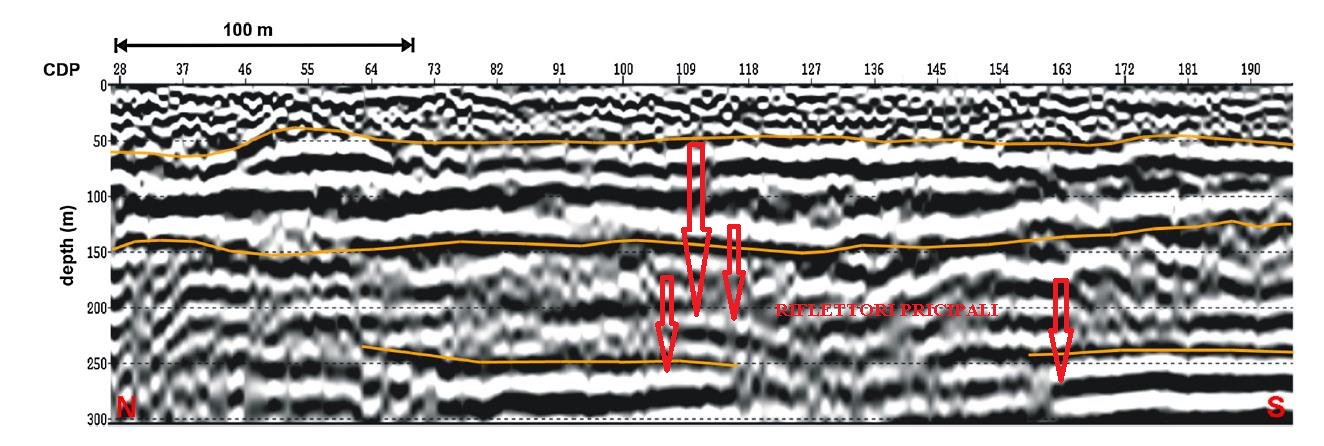
Sezione sismica acquisita nella regione Friuli-Venezia Giulia nel comune di Mereto di Tomba (UD). Il primo principale riflettore viene identificato a 50 metri di profondità. Il range tra i 50 e i 140 metri di profondità è caratterizzato dalla presenza di forti riflettori che rappresentano delle unconformity ( superficie di separazione tra due unità litologiche che rappresenta un’interruzione significativa nella sedimentazione). A circa 250 metri un forte riflettore rappresenta il bedrock (Roccia compatta, rigida, non alterata alla base di rocce / terreni rigidi o di sedimenti sciolti)
Artificial recharge of the phreatic aquifer in the upper Friuli plain, Italy, by a large infiltration basin P. Teatini, A. Comerlati, T. Carvalho, A.-Z. Gütz, A. Affatato, L. Baradello, F. Accaino, D. Nieto, G. Martelli, G. Granati, and G. Paiero, Artificial recharge of the phreatic aquifer in the upper Friuli plain, Italy, by a large infiltration basin, Environmental Earth Sciences, 73(6), 2579-2595, doi:10.1007/s12665-014-3207-8, 2015.