
Magnetometry
Magnetometry is a method of investigating the subsoil that measures the anomalies of the Earth's magnetic field originating from underground structures.
The anomalies that can be observed during a magnetometric survey…
Severity: Warning
Message: mysqli::real_connect(): Headers and client library minor version mismatch. Headers:50651 Library:50562
Filename: mysqli/mysqli_driver.php
Line Number: 201
Backtrace:
File: /home/wq32o6o3/public_html/application/core/MY_Controller_front.php
Line: 25
Function: database
File: /home/wq32o6o3/public_html/application/controllers/Tematiche.php
Line: 6
Function: __construct
File: /home/wq32o6o3/public_html/index.php
Line: 315
Function: require_once
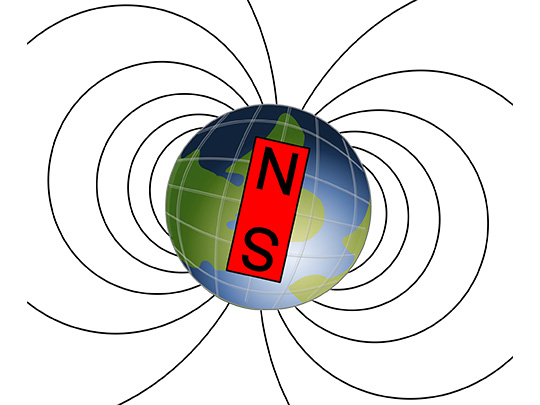
The Earth is surrounded by a magnetic field of approximately dipolar shape generated by a magnetic dipole placed inside the liquid core due to the existence of electric currents.
The magnetic poles do not coincide with the geographical ones, in fact the magnetic axis is inclined by about 11 ° with respect to the Earth's rotation axis.
When a rock is magnetized, at the moment of its formation, it acquires a magnetization that it is called primary and can give information on the direction and intensity of the magnetic field existing at the time of lithogenesis.
Magnetism is a property of an atomic or sub-atomic nature, due to the fact that many atoms substances have non-zero magnetic moments (atomic, electronic, or nuclear): these can come oriented differently from an external magnetic field.
The magnetization intensity vector, also called magnetic polarization vector (M) is the magnetic moment per unit of volume possessed by the material.
The magnetic susceptibility (χ) is a measure of how much a material will become magnetized in an applied external magnetic field; the susceptibility can be defined mathematically as the relationship between induced magnetization and applied magnetic field. t is the ratio of magnetization to the applied magnetizing field intensity H.
χ = M/H
According to the orientation assumed by elementary magnetic moments due to a magnetic field, substances can be classified in:
1) Diamagnetic materials: they magnetize in the opposite direction to that of the applied field. The molecules that compose them have null magnetic moments in the absence of external magnetic field.
2) Paramagnetic materials: magnetization is parallel and, in general, proportional to the applied field .Their molecules in the absence of external field have magnetic moments different from zero and weakly interacting
3) Ferromagnetic materials:
for a temperature that is lower than the Curie temperature, the atomic magnetic moments, even in the absence of an external field, are parallel and oriented in one same direction within regions called ferromagnetic domains. Consequently those materials can have a non-zero magnetization even in the absence of an external field. Above the temperature of Curie these substances behave as if they were paramagnetic. The cumulative effect of atomic magnetic moments gives rise to relatively large values of the magnetization (and therefore of susceptibility) for a given magnetic applied field
Magnetometry is a method of investigating the subsoil that measures the anomalies of the Earth's magnetic field originating from underground structures.
The anomalies that can be observed during a magnetometric survey…