
The geoelectric methods can be divided into two main categories: those that use natural electric currents existing in the subsoil (passive methods) and those that use artificially electric currents released…
Read moreSeverity: Warning
Message: mysqli::real_connect(): Headers and client library minor version mismatch. Headers:50651 Library:50562
Filename: mysqli/mysqli_driver.php
Line Number: 201
Backtrace:
File: /home/wq32o6o3/public_html/application/core/MY_Controller_front.php
Line: 25
Function: database
File: /home/wq32o6o3/public_html/application/controllers/Tematiche.php
Line: 6
Function: __construct
File: /home/wq32o6o3/public_html/index.php
Line: 315
Function: require_once
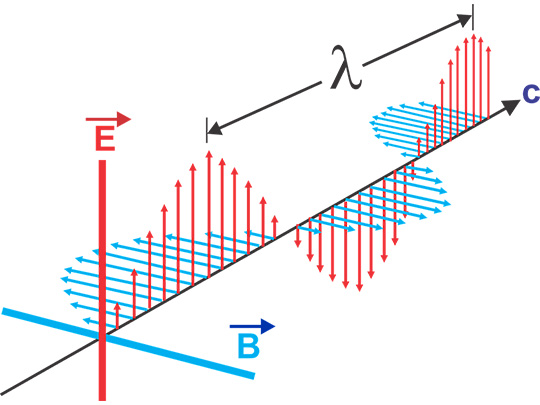
Electromagnetic waves are a physical phenomenon through which electromagnetic energy can move from one place to another by propagation. Electromagnetic waves, according to Maxwell's theory, are oscillating phenomena, generally of a sinusoidal type and are made up of two variables that vary periodically over time: the electric field and the magnetic field. The main characteristics of the electromagnetic waves depend on their fundamental property: the frequency f, that is the number of oscillations performed in a second. This quantity is measured in cycles per second or Hertz (Hz) and relative multiples and submultiples. Closely related to the frequency is the wavelength λ, which is the distance traveled from the wave during an oscillation time and corresponds to the distance between two maximums or two minimums displacements from equilibrium.
λ = 1/f
The range of all possible electromagnetic waves, depending on the frequency and the wavelength, constitutes the electromagnetic spectrum.
The geoelectric methods can be divided into two main categories: those that use natural electric currents existing in the subsoil (passive methods) and those that use artificially electric currents released…
Read more