
Gravimetric detection
Gravimetric detection consists in the measurement of the earth's gravitational field and in the detection of the anomalies that can be caused by variations in density of the bodies close…
Read moreSeverity: Warning
Message: mysqli::real_connect(): Headers and client library minor version mismatch. Headers:50651 Library:50562
Filename: mysqli/mysqli_driver.php
Line Number: 201
Backtrace:
File: /home/wq32o6o3/public_html/application/core/MY_Controller_front.php
Line: 25
Function: database
File: /home/wq32o6o3/public_html/application/controllers/Tematiche.php
Line: 6
Function: __construct
File: /home/wq32o6o3/public_html/index.php
Line: 315
Function: require_once
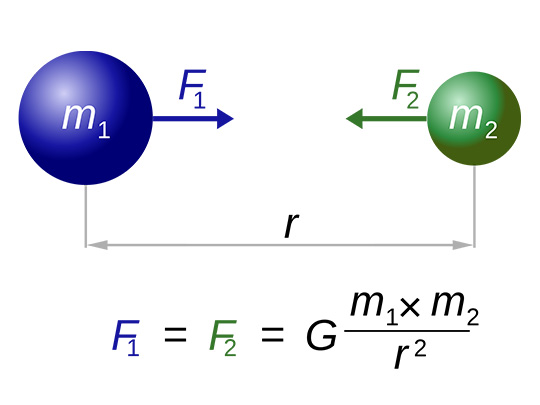
In physics, a gravitational field is a model used to explain the influence that a massive body extends into the space around itself, producing a force on another massive body. Newton's law of gravity states that the gravitational force between two bodies is proportional to the product of their masses and inversely proportional to the square of the distance between them.
Weight is the force generated by the gravitational attraction of the earth on any object and is equal to the product of the object’s mass and g, the gravitational acceleration.
Gravitational acceleration varies according to the distance from the center of mass of the Earth and the latitude but, on the Earth's surface and in a region where the curvature can be considered negligile , it can be considered constant.
On the surface of the earth, its value is 9.8 meters per square second or 32.2 feet per square second.
Gravimetric detection consists in the measurement of the earth's gravitational field and in the detection of the anomalies that can be caused by variations in density of the bodies close…
Read more